How to Plan a Useful Blog Outline Before Writing
Build an article around one reader task, a worked example and a clear review step.
In this guide
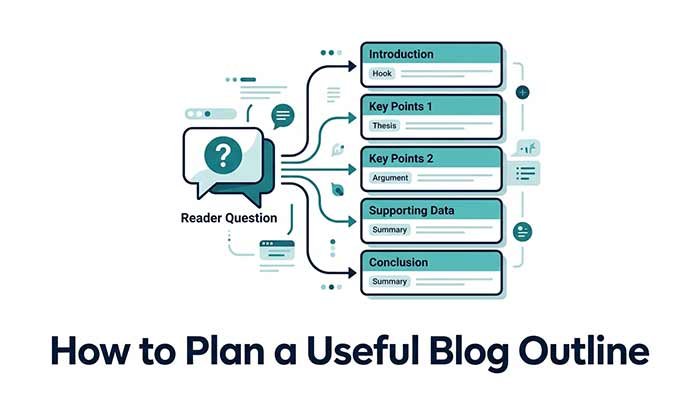
A strong outline makes the article’s purpose visible before you write long paragraphs. Start with one thing the reader should be able to understand or do. Then choose the steps and examples that support that outcome. An AI outline is helpful only if you review it against the actual topic.
Define one reader and one task
“An article about text tools” is broad. “Help an adult office worker remove duplicate lines without losing unique entries” is specific. The second goal suggests an input example, matching rules and a check of the result. It also shows which nearby topics belong in separate guides.
Write a one-sentence promise that you can fulfil. Avoid promising benefits you have not measured, such as higher rankings or increased sales. The outline should explain the working feature, not advertise imagined results.
Ask for headings with a purpose
Outline a practical guide to removing duplicate lines. The reader is an adult office worker. Include a short example, exact and ignore-case matching, the effect of spaces and a final review checklist. Explain the purpose of each section. Do not add claims about detecting duplicate contacts or similar meanings.
Ask why each heading belongs. If two sections have the same purpose, combine them. A paragraph about “benefits” may be unnecessary if the introduction already explains the task. Add detail where a reader could make a real mistake.
Build the example before the full draft
Use a tiny list such as Delhi, Mumbai, Delhi. Show that exact duplicate removal retains the first Delhi and Mumbai. Add “delhi” to explain ignore-case mode and “Delhi ” to demonstrate a trailing-space difference. This concrete example is more informative than several vague paragraphs.
Test any tool steps yourself. If the interface labels differ from the outline, fix the plan before writing. A guide should reflect the current feature and state its boundaries clearly.
Decide what needs evidence
Separate demonstrated behaviour from outside claims. You can verify that a local tool produces a given result. Claims about market demand, Google ranking or software standards need their own reliable sources. Do not let the assistant invent research, statistics or first-hand experience.
Draft, then remove repetition
Turn the approved headings into paragraphs that move the reader forward. Keep the example near the relevant explanation. End with a practical review step, such as comparing unique lines with the original, rather than repeating the introduction in different words.
The right length is the length needed to complete the task accurately. Extra headings do not make an article more useful. If a section cannot add a step, example, limitation or answer to a likely question, reconsider whether it belongs.
Questions that often come up
Should every guide have the same structure?
A consistent visual layout helps, but the explanation should fit the task. A calculation guide needs a formula; a writing guide may need a before-and-after example.
Can an outline replace research?
No. It organizes the work. Check outside facts and demonstrate the steps before publishing the article.
Try the related pages
This guide was prepared with AI assistance and checked against the behaviour of the ReDeepSeek tools. Review AI answers before using them and report unclear examples through our Contact page.