How to Review AI Grammar Edits Without Changing Your Meaning
Separate necessary corrections from optional style changes and check the revised passage.
In this guide
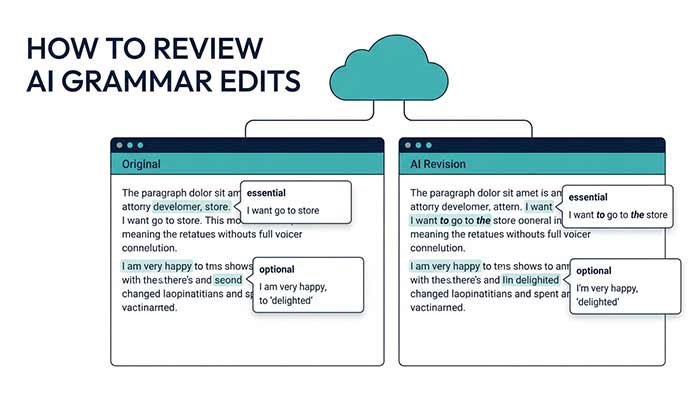
A grammar review should make a passage easier to understand while preserving the author’s point. AI often offers broader rewrites than you asked for, so a good review begins by defining the scope. Decide whether you want error correction, simpler wording or a different tone.
Give the original and the editing goal
Paste a short passage without private information. Name your preferred variety of English where it matters and say whether the informal voice should remain. Ask the assistant to explain significant edits rather than silently rewriting every sentence.
Review this sentence for grammar and clarity: “The team have shared their notes, but the deadline were unclear.” Use Indian English where appropriate. Give one corrected version, explain the subject–verb choices and preserve the meaning. Distinguish a necessary correction from an optional style preference.
Collective nouns can take different agreement patterns depending on variety and emphasis. “Deadline were” needs attention because the singular noun normally pairs with “was”. A useful explanation identifies that problem without pretending that every style choice has one universal answer.
Compare the facts after the edit
Check names, dates, quantities and statements about responsibility. A sentence saying “the report may be ready” must not become “the report will be ready”. The second version commits to an outcome that the original did not promise.
Watch for changes to quoted text and specialist terms. An unfamiliar product name is not necessarily a spelling mistake. If the model changes a technical word, confirm the term with an authoritative source or the person responsible for the document.
Ask for a smaller revision
If the first result changes too much, narrow the request. You might ask for punctuation and agreement only, with no vocabulary substitutions. Or request two versions: minimal corrections and a clearer rewrite. Comparing them helps you decide how much editing the piece needs.
Show a minimally corrected version and a separate optional clarity rewrite. Do not add facts, remove qualifications or change the level of certainty. Explain any sentence whose meaning is ambiguous instead of guessing.
Read the revised paragraph aloud
A mechanically correct paragraph can still sound unnatural. Reading it aloud reveals repeated phrases and awkward rhythm. Check that pronouns have clear referents and that a long sentence does not hide the main action. Choose words you understand and would use yourself.
Keep the author in control
Treat suggestions as options. Accept an edit only when you understand why it helps. For important material, obtain a human review that matches the subject and audience. The assistant cannot certify accuracy, guarantee error-free writing or verify claims simply by correcting their grammar.
Questions that often come up
Should I accept every suggested correction?
No. Check meaning and style in context. Some suggestions are optional, and a rewrite can introduce an error that was not in the original.
Does a grammar check verify facts?
No. A sentence can be grammatical and factually wrong. Verify factual claims as a separate task.
Try the related pages
This guide was prepared with AI assistance and checked against the behaviour of the ReDeepSeek tools. Review AI answers before using them and report unclear examples through our Contact page.